Consumer disputes have become increasingly common across India. Every day, thousands of people purchase products online, subscribe to digital services, book travel, take insurance policies, or hire professionals with the expectation of receiving quality goods and services.
Unfortunately, delayed deliveries, defective products, hidden charges, misleading advertisements, denied refunds, and poor customer service continue to affect consumers. When a business refuses to resolve a genuine grievance, the law provides an effective solution through the consumer dispute redressal system.
If you are searching for information about a consumer court complaint India, you are likely looking for a practical way to recover your money, receive compensation, or hold a company accountable. The good news is that filing a consumer complaint is now easier than ever. With the Government's digital initiatives, consumers can submit complaints online through the modernized e-Jagriti platform, which builds on the earlier e-Daakhil system. The platform supports online filing, fee payment, document uploads, virtual hearings, and case tracking from anywhere in India.
This guide explains every stage of the consumer complaint process in simple language. Whether your dispute involves an e-commerce website, builder, hospital, insurance company, bank, airline, educational institution, or service provider, you will learn how to protect your rights and improve your chances of obtaining relief.
What Is a Consumer Court Complaint?
A consumer court complaint is a legal action filed by a consumer against a seller, manufacturer, service provider, or business that has caused financial loss or hardship through defective goods, deficient services, unfair trade practices, or misleading advertisements. Consumer courts were established to provide faster and more affordable justice compared to traditional civil courts.
Unlike lengthy civil litigation, consumer commissions are designed to simplify dispute resolution. Individuals can often represent themselves without hiring a lawyer, although legal representation is beneficial in complex cases involving high-value claims or intricate legal issues.

Understanding the Consumer Protection Act, 2019
The Consumer Protection Act, 2019 replaced the earlier 1986 law to address the realities of today's digital economy. Online shopping, app-based services, digital payments, and e-commerce transactions now dominate consumer spending. The updated law reflects these changes and offers stronger safeguards.
The Act protects consumers from:
- Defective products
- Poor-quality services
- Unfair contracts
- False advertisements
- Product liability
- Overcharging
- Unfair trade practices
One of the most significant improvements is the availability of online complaint filing. Instead of visiting multiple offices, consumers can file complaints, upload evidence, pay fees digitally, and monitor proceedings online. The Government's e-Jagriti initiative further enhances this system with multilingual support, virtual hearings, and AI-assisted case management.
For businesses, the Act increases accountability. Companies that ignore valid complaints or engage in deceptive practices face legal consequences, including compensation orders and corrective directions.
Who Can File a Consumer Complaint?
Many people mistakenly believe that only lawyers or large organizations can approach consumer courts. In reality, the law allows a wide range of complainants to seek redress.
You can generally file a complaint if you are:
- A person who purchased goods for personal use.
- A person who hired or paid for services.
- A registered consumer association.
- Multiple consumers with the same grievance.
- A legal heir or representative in appropriate circumstances.
- The Central or State Government in eligible matters.
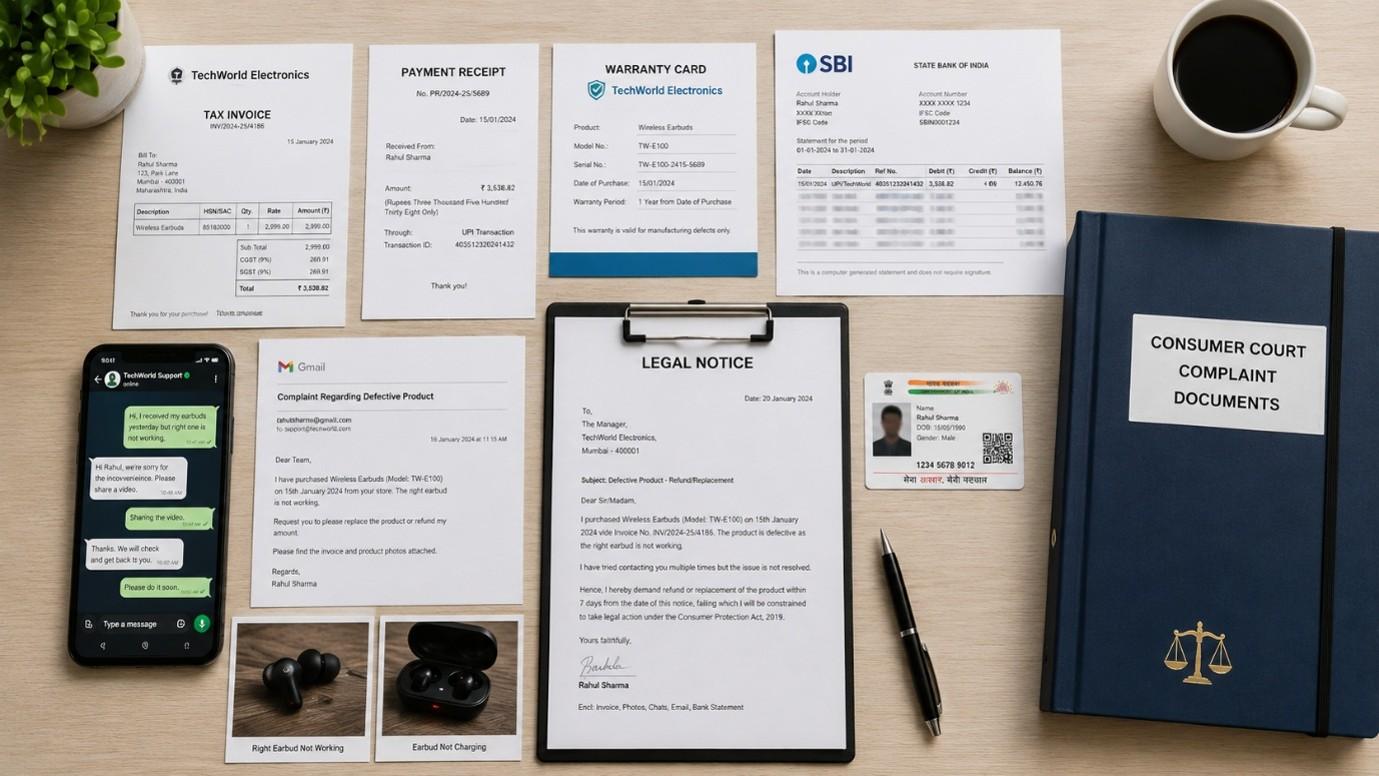
Before filing, gather supporting evidence such as invoices, payment receipts, emails, chat records, photographs, warranty documents, and correspondence with the seller. Clear documentation often plays a decisive role in the outcome of consumer disputes.
Common Consumer Problems That Can Be Taken to Consumer Court
One of the biggest advantages of the Consumer Protection Act, 2019 is that it covers a wide range of consumer disputes. Whether you purchased a product from a local retailer or an online marketplace, hired a professional service, or entered into an agreement with a builder or insurance company, you have the right to seek legal remedies if the business fails to fulfill its obligations.
Consumer courts examine whether the seller or service provider acted unfairly, negligently, or in violation of consumer rights. If sufficient evidence is presented, the commission can direct the business to refund money, replace defective goods, pay compensation, or discontinue unfair practices.
Some of the most common complaints filed before consumer commissions include defective electronic products, damaged goods delivered through e-commerce platforms, delayed possession of apartments by builders, insurance claim rejections without valid reasons, medical negligence, banking errors, unauthorized deductions, airline refund disputes, travel package fraud, poor internet and telecom services, educational institution disputes, and misleading advertisements.
Before filing a complaint, it is advisable to communicate with the business and give it a reasonable opportunity to resolve the issue. Keep copies of emails, invoices, receipts, WhatsApp conversations, and any written communication. These records demonstrate that you attempted to settle the dispute amicably and strengthen your case before the consumer commission. Even if the company refuses to cooperate, your documented efforts show good faith and can influence the outcome in your favor.
Benefits of Filing a Consumer Court Complaint
Many consumers hesitate to take legal action because they believe court proceedings are expensive, complicated, or time-consuming. Consumer commissions were created to remove these barriers and provide accessible justice for ordinary citizens. Compared to traditional civil litigation, the consumer dispute resolution system is designed to be more affordable, faster, and easier to navigate.
One of the greatest benefits is the availability of multiple remedies under a single proceeding. Depending on the facts of the case, the commission may order a refund of the purchase price, replacement of defective goods, repair of the product, compensation for financial losses, reimbursement of litigation expenses, discontinuation of unfair trade practices, or corrective advertising. In cases involving mental harassment or negligence, compensation may also include damages for emotional distress.
Another significant advantage is the growing digitization of the complaint process. Through the Government's online filing system, consumers can submit complaints, upload supporting documents, pay prescribed fees, and monitor case progress without frequent visits to the commission. Virtual hearings have also improved accessibility for consumers living in different cities or states.
Online vs Offline Filing of Consumer Complaints
Consumers in India now have two primary methods for filing complaints. The first is the traditional offline process, where the complaint is submitted physically before the appropriate District, State, or National Consumer Disputes Redressal Commission. The second, and increasingly preferred option, is the online filing system through the Government's digital consumer grievance platform (e-Jagriti).
Online Filing (e-Jagriti)
Register from home, upload scanned documents, make digital payments, receive electronic notices, and participate in virtual hearings remotely. Extremely time-saving.
Offline Filing
Submit physical petitions in prescribed format directly to the court registry, print copies for all parties, submit manual stamp/proof of payment. Good if assistance is needed.
Regardless of the filing method, maintaining complete and organized documentation significantly improves the chances of a successful outcome. For complex disputes involving builders, insurance companies, hospitals, financial institutions, or large corporations, consulting an experienced consumer lawyer before filing can help avoid procedural errors and strengthen legal arguments.
Documents Required for Filing a Consumer Court Complaint
Proper documentation is one of the most important factors in determining the success of a consumer complaint. Consumer commissions rely heavily on documentary evidence to establish the existence of a transaction, identify deficiencies in service, and determine if compensation should be awarded. Missing records weaken a claim.
| Document Required | Legal Purpose |
|---|---|
| Invoice or Purchase Bill | Proof of purchase |
| Payment Receipt | Confirms payment |
| Warranty Card | Product warranty details |
| Agreement or Contract | Service obligations |
| Email Communication | Evidence of complaints and notices |
| WhatsApp Chats | Customer communication record |
| Photographs or Videos | Proof of physical defects or damage |
| Bank Statements | Financial transaction records |
| Identity Proof | Verification of identity |
| Address Proof | Jurisdiction confirmation |
| Legal Notice (if issued) | Pre-litigation attempt to resolve dispute |
* Note: Digital evidence is highly valued. Screenshots of online orders, payment logs, support chats, and recorded customer service calls should be preserved and cataloged chronologically.
Step-by-Step Process to File a Consumer Court Complaint
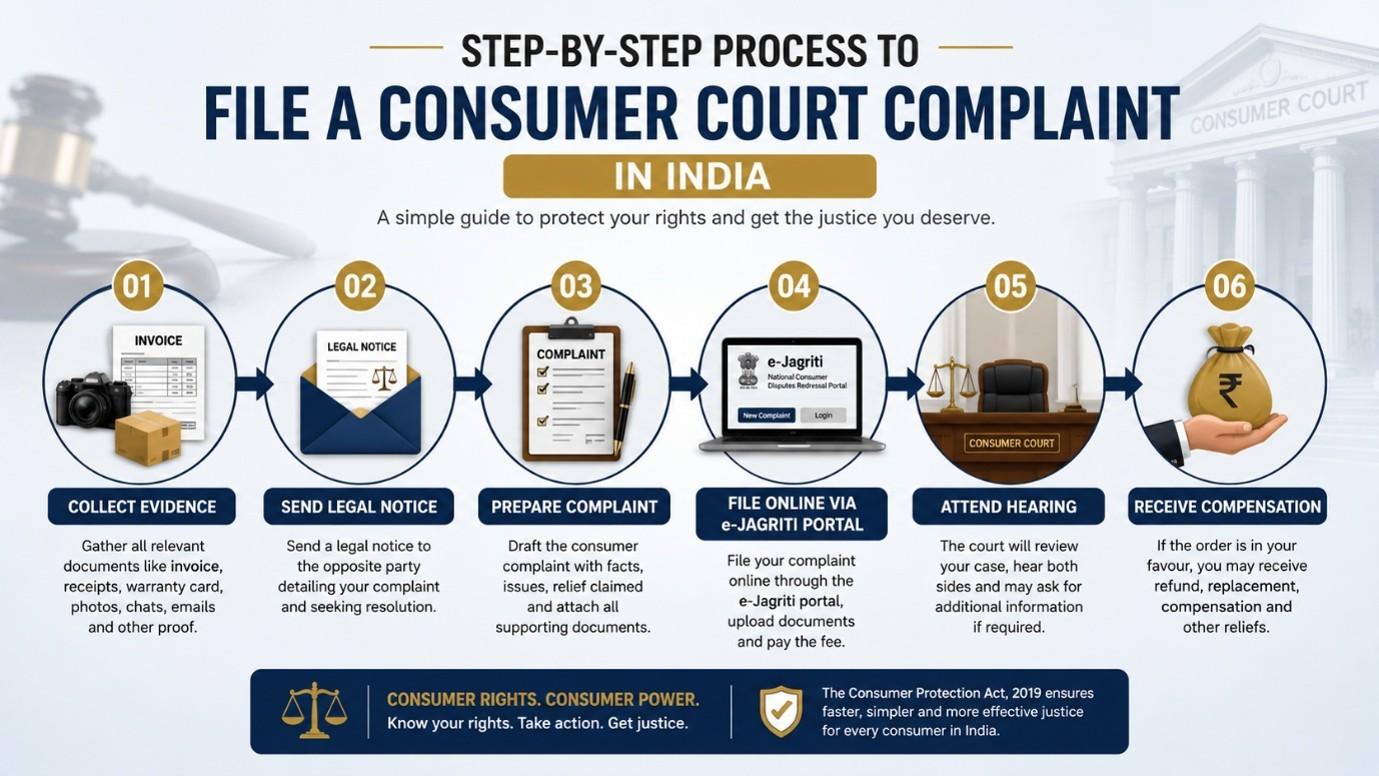
Following the correct legal procedure ensures that your petition moves smoothly without objections.
Collect Evidence
Gather all transactions history: invoices, payment receipts, contracts, warranty cards, emails, photographs, videos, and correspondence.
Send a Legal Notice
Clearly describe the dispute, explain your claim, and provide a reasonable period (usually 15 days) for the business to respond.
Prepare the Complaint
Draft the petition details: parties info, facts of dispute, cause of action, relief sought, compensation claimed, and attach evidence.
File Before Commission
Determine correct commission based on jurisdiction/claim value. Submit the complaint online via e-Jagriti or offline with fees.
Attend Hearings
Respond promptly to court notices, submit additional records if directed, and present your case. Hearings can be virtual.
Receive the Order
If the court finds merit, they issue an order directing refund, replacement, repair, or mental agony compensation.
Consumer Court Fees
Consumer commissions are designed to provide affordable access to justice. Filing fees are generally much lower than those associated with civil litigation. The exact fee depends on the value of the claim and applicable rules. Additional expenses may include document preparation, notarization, courier charges, expert opinions, or legal representation if you choose to engage an advocate.
Although self-representation is permitted, professional legal assistance can be valuable in disputes involving substantial compensation, technical evidence, contractual interpretation, or multiple opposite parties. An experienced consumer lawyer ensures that pleadings comply with legal requirements.
Limitation Period for Filing a Complaint
A consumer complaint must be filed within two (2) years from the date on which the cause of action arises.
This could be the date of delivery of defective goods, denial of a refund, rejection of an insurance claim, or occurrence of the deficient service. Delaying beyond two years without documented sufficient reasons will result in the court dismissing your case.
Compensation Available in Consumer Court
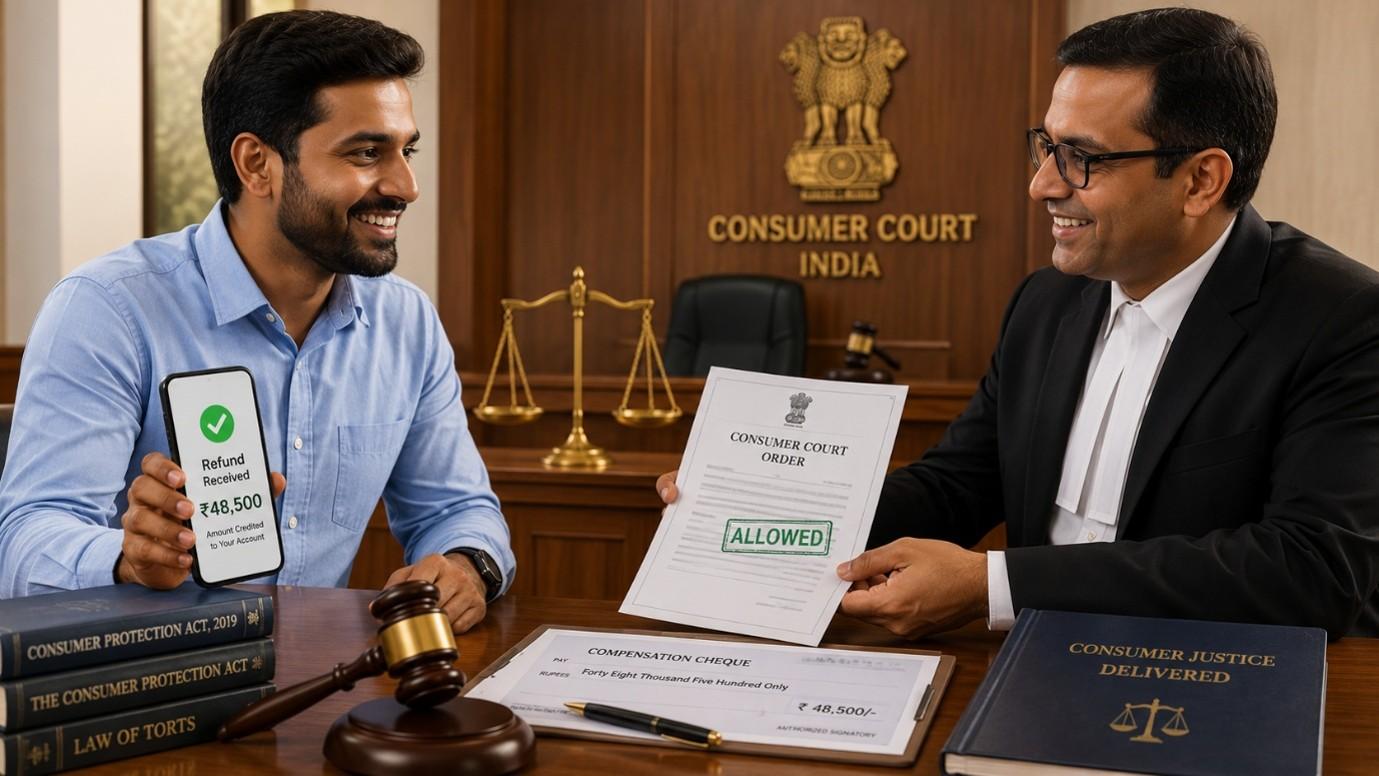
The objective of the consumer protection framework is to restore consumers to the position they would have occupied had the deficiency or unfair practice not occurred. Depending on the circumstances, the commission may grant:
Common Mistakes to Avoid
Many complaints fail due to procedural slips. Key errors include: filing before the wrong commission (lack of territorial/pecuniary jurisdiction), incomplete evidence files, emotional/unsupported claims of massive damage without receipts, and filing beyond the 2-year limitation timeline.
Seeking legal guidance before drafting a complaint mitigates these risks, assuring a clean presentation of evidence and precise legal arguments.
How Tzedek Law Can Help
At Tzedek Law, our legal team provides comprehensive advocacy under the Consumer Protection Act, 2019. Our representation spans legal consultation, draft sending of statutory pre-litigation legal notices, consumer complaint drafting, online/offline filing, settlement negotiation, and representation before District, State, and National Consumer Commissions.
We construct robust, evidence-backed petitions ensuring you receive the compensation, refunds, and justice you deserve.
Conclusion
Filing a consumer court complaint in India is an effective way to hold businesses accountable. Modern digitisation has streamlined the filing and hearing processes. However, compiling appropriate evidence and filing within statutory limits remains critical.
If your rights have been compromised by poor services, defective products, or fraudulent agreements, taking timely action is vital.
Frequently Asked Questions
You can file a complaint online through the Government's consumer complaint portal (e-Jagriti/e-Daakhil) or submit it physically before the appropriate District, State, or National Consumer Commission. Keep invoices, receipts, communication records, and supporting evidence ready before filing.
No. Individuals can represent themselves before consumer commissions. However, hiring a consumer lawyer is highly advisable for complex disputes involving high-value claims, insurance, medical negligence, banking disputes, or real estate matters.
Depending on the facts of the case, the commission may award: refund of the purchase price, replacement of defective products, free repair/rectification, compensation for financial losses, compensation for mental harassment/emotional distress, litigation costs, interest on awarded amounts, and discontinuation of unfair trade practices.
Yes. Consumer complaints can be filed against e-commerce platforms, online sellers, digital service providers, and marketplaces if they supply defective goods, fail to deliver products, refuse refunds, or engage in unfair trade practices.
Generally, you should keep: purchase invoices, payment receipts, warranty cards, agreement or contracts, email communication, WhatsApp chats, photographs or videos of defects, bank statements, identity proof, address proof, and a legal notice (if issued).