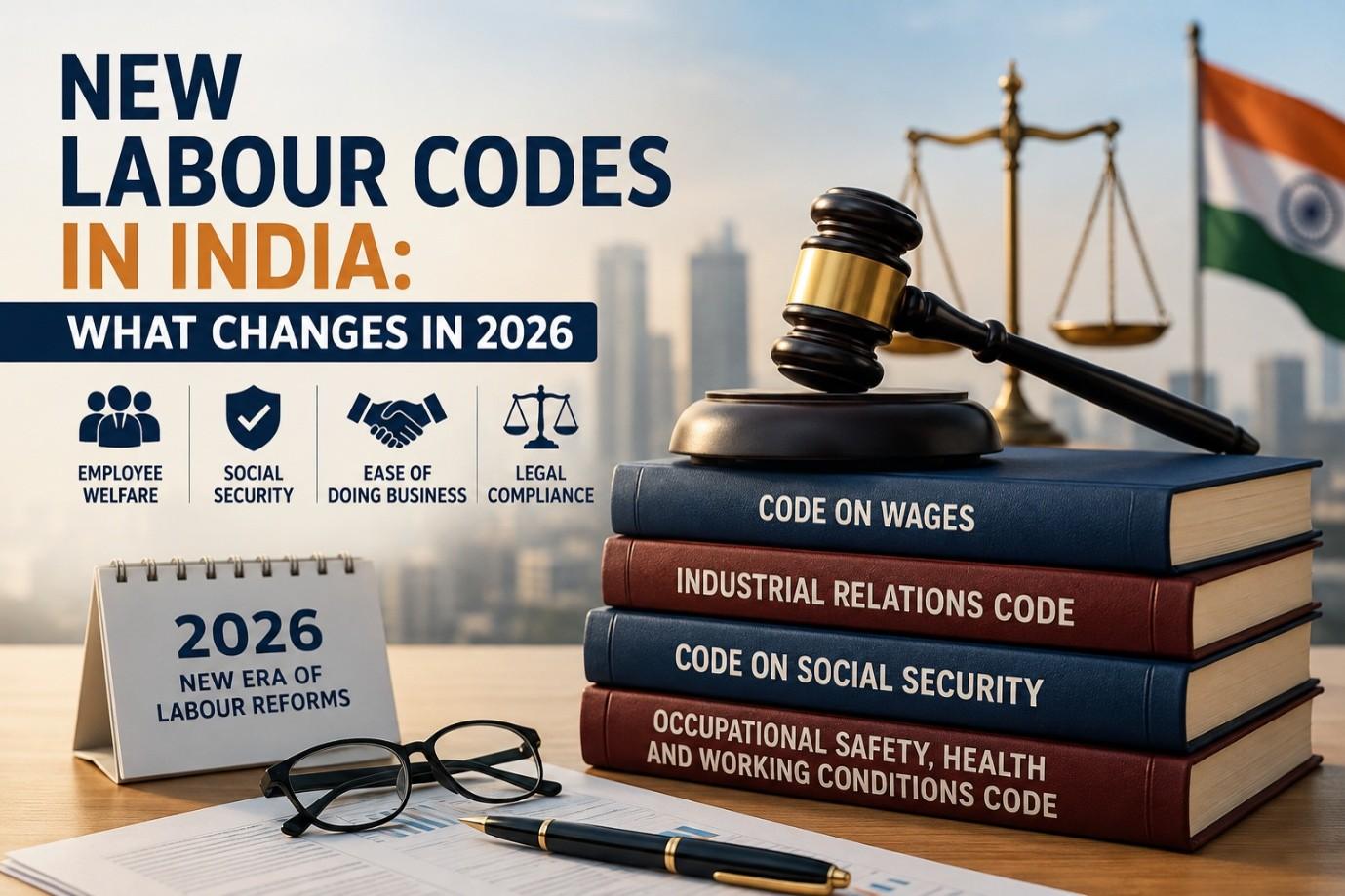
India's employment law framework has undergone one of its biggest changes in decades.
The new labour codes consolidate numerous central labour laws into four major codes covering wages, industrial relations, social security, and occupational safety. The four Codes came into effect on 21 November 2025, and the Ministry of Labour & Employment has since issued rules and detailed FAQs to clarify implementation.
For employers, this is not simply a legal update. It can affect payroll structures, appointment letters, social-security calculations, employment policies, workplace safety, contractor arrangements and HR documentation.
For employees, the changes can affect how wages are calculated, how benefits are structured and how certain employment protections operate.
The important point is this: businesses should not treat the new labour codes as a document-update exercise alone. They require a broader compliance review.
This guide explains the four Codes, the major changes, what employers and employees should check, and practical steps businesses can take in 2026.

What Are the New Labour Codes?
The new labour framework consists of four central laws:
| Labour Code | Main Area |
|---|---|
| Code on Wages, 2019 | Wages, minimum wages, payment of wages and bonus |
| Industrial Relations Code, 2020 | Trade unions, industrial disputes and employment relations |
| Code on Social Security, 2020 | PF, ESI, gratuity and wider social security |
| Occupational Safety, Health and Working Conditions Code, 2020 | Workplace safety, health, working conditions and related matters |
These four Codes consolidate and rationalise several earlier central labour laws. The official Ministry of Labour & Employment maintains the Codes, rules, implementation material and FAQs.
The enacted Codes are also available through India Code, the Government's official legal database.
Why Were the Labour Laws Changed?
India previously operated under many central labour statutes dealing separately with wages, industrial disputes, factories, contract labour, social security and other employment matters.
The four Codes attempt to create a more consolidated framework.
The objective is to simplify compliance while strengthening protections relating to wages, social security, workplace safety and employment conditions.
However, consolidation does not mean every employer can simply replace old HR documents with one standard policy.
Applicability still depends on the nature of the establishment, workforce, activity, employee category, state-level requirements and the specific provision involved.
Are the New Labour Codes in Force?
Yes.
The Central Government implemented all four Labour Codes with effect from 21 November 2025. The Ministry of Labour & Employment now publishes implementation material and Central Rules for the Codes.
The Ministry has also published 2026 FAQs addressing practical questions involving wages, gratuity, fixed-term employment, social security, overtime and other matters. This makes 2026 an important compliance year for employers. A Government implementation announcement highlights the roadmap for enforcement.
Do not rely on a labour-law article published several years ago. The implementation position has developed significantly since the Codes were enacted in 2019 and 2020.
Employers should check the latest Central and applicable State rules, notifications and official FAQs before changing payroll or employment policies.
The Four New Labour Codes Explained
1. Code on Wages, 2019
The Code on Wages, 2019 brings together important rules concerning wages, minimum wages, payment of wages and bonus.
One of the most discussed changes is the statutory definition of "wages."
Under the Code, wages broadly include basic pay, dearness allowance and retaining allowance. Where specified allowances exceed 50% of total remuneration, the excess is added back to wages for statutory calculations. The Ministry's FAQ confirms that this definition applies across all four Labour Codes.
What Does the 50% Wage Rule Mean?
Consider a simplified example.
Suppose an employee receives total remuneration of ₹60,000 per month.
The employer may structure the compensation using basic salary and several allowances. If the excluded allowances cross the permitted percentage, the excess may be added back into the statutory wage calculation.
This can influence calculations connected with benefits such as PF, gratuity and bonus, depending on the applicable statutory provision.
The exact calculation should therefore be reviewed against the employee's actual compensation structure rather than applying a blanket formula.

Minimum Wage Is Not the Same as Wages
This distinction is important.
- Minimum wage is the minimum amount prescribed by the appropriate government.
- Wages are a statutory concept used for calculating benefits and compliance under the Codes.
- The Ministry has specifically clarified that the two terms should not be treated as identical.
Businesses should review:
- Basic salary
- Dearness allowance, where applicable
- Fixed and variable allowances
- Performance incentives
- Reimbursements
- Overtime payments
- Bonus calculations
- Statutory deductions
- Payroll software configuration
- Salary structures mentioned in employment agreements
2. Industrial Relations Code, 2020
The Industrial Relations Code deals with the relationship between employers and workers.
It brings together important areas involving:
- Trade unions
- Industrial disputes
- Standing orders
- Strikes and lockouts
- Retrenchment
- Lay-offs
- Closure
- Dispute resolution mechanisms
For businesses with a significant workforce, these provisions can become particularly important during restructuring, workforce reductions, disputes or changes in employment conditions. If you are navigating workforce changes, seeking Service Law legal guidance from our team can help you resolve worker disputes in compliance with the new rules.
Why Employers Should Pay Attention
A company may have a legally sound business reason for restructuring but still face risk if the process is handled incorrectly.
For example, an employer planning a workforce reduction should not rely solely on an internal management decision.
The company should examine:
- Which employees are affected?
- What category of workers do they fall into?
- What statutory procedure applies?
- What notice or compensation requirements apply?
- Are standing orders applicable?
- Are there contractual commitments?
- Are there pending disputes?
- Are there collective bargaining implications?
The correct process can be as important as the commercial reason behind the decision.
3. Code on Social Security, 2020
The Code on Social Security, 2020 consolidates several areas of social-security law.
It covers matters including:
- Provident fund
- Employees' State Insurance
- Gratuity
- Maternity benefits
- Employee-related social-security provisions
- Gig and platform workers
- Unorganised workers
The Code expressly seeks to extend social-security coverage across organised, unorganised and other sectors.
Gratuity Under the New Labour Codes
Gratuity is one of the areas employers are closely reviewing.
The Ministry has clarified that the revised gratuity framework applies from 21 November 2025.
There are also specific provisions affecting fixed-term employees. The Ministry's 2026 FAQ states that a fixed-term employee can become eligible for gratuity after rendering one year of service under the contract, subject to the applicable statutory framework.
Why This Matters to Employers
A business should review:
- Existing gratuity provisions
- Employee tenure records
- Fixed-term contracts
- Payroll calculations
- Accounting provisions
- HR policies
- Employee benefit disclosures
A salary or employment structure that looked appropriate under an older framework may need to be reassessed. For official PF information, employers and employees should refer to the Employees' Provident Fund Organisation.
4. Occupational Safety, Health and Working Conditions Code, 2020
The OSH Code deals with workplace health, safety and working conditions.
It addresses areas such as:
- Workplace safety
- Health and welfare
- Working hours
- Annual leave
- Contract labour
- Inter-state migrant workers
- Employment of women
- Workplace records and registers
- Inspection and compliance
The official India Code record shows the OSH Code's enforcement date as 21 November 2025. Refer to the Occupational Safety, Health and Working Conditions Code, 2020 for official updates.
Working Hours and Overtime
A common misconception is that the new framework simply permits employers to make employees work longer without additional protection.
The Ministry's FAQ states that the standard is 8 hours per day and 48 hours per week, with permitted flexibility subject to the Code and overtime requirements. Overtime is payable at twice the rate of wages under the applicable provisions.
Employers should therefore review attendance systems and overtime calculations rather than if a new working-hours structure automatically removes overtime liability.
How Do the New Labour Codes Affect Salary?
- This is one of the most important questions for employees and employers.
- The answer is: it depends on the employee's existing salary structure.
- The new definition of wages can affect the statutory base used for certain benefits and contributions.
Example Calculation
Imagine an employee receives:
- Basic pay: ₹25,000
- Allowances: ₹35,000
- Total remuneration: ₹60,000
The employer should not assume that all ₹35,000 of allowances will always remain outside the statutory definition of wages.
The 50% rule must be examined under the Code and applicable rules. The Ministry has clarified that amounts exceeding the prescribed percentage can be added back for statutory purposes.
If your salary structure has recently changed, review:
- Basic salary
- Allowances
- PF contribution
- Gratuity calculation
- Bonus eligibility
- Overtime
- Payslips
- Employment agreement
Do not judge the impact simply by looking at the gross salary. The more useful question is: How has the statutory wage base changed?
Do the New Labour Codes Increase PF Contributions?
Not automatically for every employee by the same amount.
The impact depends on the employee's remuneration structure, statutory coverage and the applicable provisions.
Because the definition of wages is important for statutory calculations, businesses should review how their compensation components interact with PF and other social-security obligations.
The Ministry has specifically stated that the revised definition of wages applies from 21 November 2025.
Employers should reconcile payroll calculations with applicable EPFO requirements rather than relying on a generic percentage-based assumption.
What Changes for Fixed-Term Employees?
Fixed-term employment has become an important part of India's modern employment framework.
A fixed-term employee is directly engaged by the employer under a written contract for a fixed period.
The Ministry has clarified that fixed-term employment under the Social Security Code refers to employees directly engaged by the employer and is distinct from contract labour supplied through a contractor.
This distinction matters.
Example Scenario
A company hires:
- Employee A: Directly employed for a two-year fixed term.
- Employee B: Works at the company through an outside manpower contractor.
The legal treatment of these two arrangements may be different. Employers should therefore avoid using "contract employee" and "fixed-term employee" as if they are always the same category.
Appointment Letters Become Even More Important
Employment documentation is no longer something businesses should treat as an HR formality.
The 2026 Central Rules prescribe a detailed appointment-letter format containing information such as employee identity details, designation, type of employment, joining date, wages, benefits and social-security applicability.
If you are a startup or growing business, seeking Contract drafting assistance will help ensure your custom onboarding documents protect your interests.
- Employee name
- Date of joining
- Designation
- Employment type
- Salary and wage components
- Working conditions
- Benefits
- Notice provisions
- Confidentiality
- Leave
- Applicable policies
- Statutory benefits
- Employer and employee obligations

For startups and growing companies, standardising employment documentation early can prevent disputes later.
What Do the New Labour Codes Mean for Gig and Platform Workers?
The Code on Social Security specifically recognises gig workers and platform workers.
This is significant because India's workforce increasingly includes people working through digital platforms and non-traditional arrangements.
The Government has stated that the new framework expands social-security coverage to organised and unorganised workers, including gig and platform workers.
The Code also provides for mechanisms involving aggregators and social-security schemes for gig and platform workers.
However, the exact obligations should be assessed against the applicable provisions, notifications and schemes rather than if every platform worker receives identical benefits.
How Employers Should Prepare for the New Labour Codes
A business does not need to wait for a labour dispute before reviewing compliance.

A practical review can be divided into six stages. Engaging Corporate and commercial legal support ensures that your transition is systematically managed.
Step 1: Audit Your Workforce
Prepare a list of: Permanent employees, Fixed-term employees, Contract workers, Temporary employees, Part-time employees, Consultants, Apprentices, and Gig or platform arrangements. Do not assume that everyone working for the business has the same legal status.
Step 2: Review Salary Structures
Check: Basic pay, Allowances, Incentives, Reimbursements, Overtime, Bonus, PF, and Gratuity. Identify structures that may require recalculation under the statutory definition of wages.
Step 3: Update Employment Documents
Review: Appointment letters, Employment agreements, HR policies, Leave policies, Overtime policies, Disciplinary procedures, Termination clauses, Fixed-term contracts, and Contractor agreements.
Step 4: Review Workplace Compliance
Check whether your organisation has appropriate systems for: Working hours, Attendance, Overtime, Workplace safety, Registers, Records, Accident reporting, and Employee welfare.
Step 5: Review Social-Security Obligations
Confirm the company's approach to: PF, ESI, Gratuity, Maternity benefits, and Applicable social-security schemes. Official EPFO information should be checked alongside the Labour Ministry's current rules and notifications.
Step 6: Obtain Legal Review
A payroll consultant can identify calculation issues. An HR consultant can review operational policies. But where there is uncertainty about statutory interpretation, employment contracts, retrenchment, disciplinary action or a potential dispute, legal advice can help determine the appropriate course of action.
Common Mistakes Businesses Should Avoid
Mistake 1: Changing Basic Salary Without a Full Review
Increasing or decreasing basic pay without understanding its effect on statutory benefits can create unexpected costs.
Better approach: Model the financial and legal impact before changing the salary structure.
Mistake 2: Treating Every Worker as an Employee
Consultants, contractors, fixed-term employees and direct employees may have different legal relationships.
Better approach: Document the actual relationship and review the applicable Code.
Mistake 3: Copying an Appointment Letter From the Internet
A generic employment agreement may not reflect the company's business, workforce or applicable law.
Better approach: Use legally reviewed employment documentation.
Mistake 4: Ignoring State-Level Requirements
Labour compliance can involve both central and state-level requirements.
Better approach: Check the applicable State rules and notifications for the location and nature of the establishment.
Mistake 5: Assuming the New Codes Remove All Old Compliance Immediately
Transition provisions and applicable rules matter. The Ministry has explained that, during transition, previous rules may continue to operate to the extent they are consistent with the Codes until new rules are finalised.
Better approach: Follow the latest official notifications and applicable rules rather than relying on assumptions.
New Labour Codes Compliance Checklist for Employers
Before treating your organisation as fully reviewed, ask:
What Should Employees Do?
Employees should not panic simply because the term "new labour codes" appears in a salary or HR communication.
Instead, compare your employment documents before and after any proposed change.
- Appointment letter
- Employment agreement
- Payslips
- Salary revision letters
- PF statements
- Bonus records
- Leave records
- HR communications
- Termination or resignation documents
If your employer proposes a major change to your compensation, employment status or working conditions, ask for the change in writing. If there is a dispute, documentation can become critical evidence.
How Tzedek Law Can Help With Labour and Employment Matters
Labour-law compliance is rarely limited to one question.
A business may need advice on an employment agreement, salary structure, employee dispute, service matter, contractor arrangement or regulatory issue at the same time.
Tzedek Law's practice includes Service Law, Corporate & Commercial Law, Contract Drafting and regulatory/compliance-related legal work, with advocates experienced in employment-related disputes and advisory matters. You can read our practical legal guidance for another detailed walkthrough on consumer advocacy.
Frequently Asked Questions (FAQs)
The four Codes are the Code on Wages, 2019; Industrial Relations Code, 2020; Code on Social Security, 2020; and Occupational Safety, Health and Working Conditions Code, 2020.
Yes. The four Labour Codes came into effect on 21 November 2025. Employers should also check the latest Central and applicable State rules and notifications.
The revised statutory definition of wages can affect the wage base used for certain statutory calculations. Specified allowances exceeding the applicable 50% threshold may be added back into wages.
Yes. The Ministry has clarified that the revised gratuity provisions under the Code apply from 21 November 2025. Special rules also apply to certain fixed-term employees.
Employers should review employee classification, salary structures, appointment letters, employment contracts, PF/ESI and gratuity calculations, overtime, working hours, workplace safety, records and applicable State requirements.
Conclusion
The new labour codes represent a major change in India's employment-law framework.
The four Codes now cover wages, industrial relations, social security and occupational safety under a consolidated structure. Since implementation began on 21 November 2025, employers should treat 2026 as a practical compliance-review period rather than waiting for a dispute or inspection.
For businesses, the immediate priorities should be clear:
Review the workforce. Review salary structures. Review employment documents. Review social-security obligations. Review workplace policies. Check the latest Central and State rules.
Employees should similarly understand how changes to wages, employment status and benefits affect their individual position. The law is complex, but compliance does not have to be confusing.
A careful legal review can help a business identify problems early, reduce avoidable disputes and make employment decisions with greater confidence.
If your company needs help reviewing its employment contracts, labour-law compliance or an employee dispute, professional legal advice can help you determine the right next step. Feel free to contact our team for a legal consultation for businesses today.