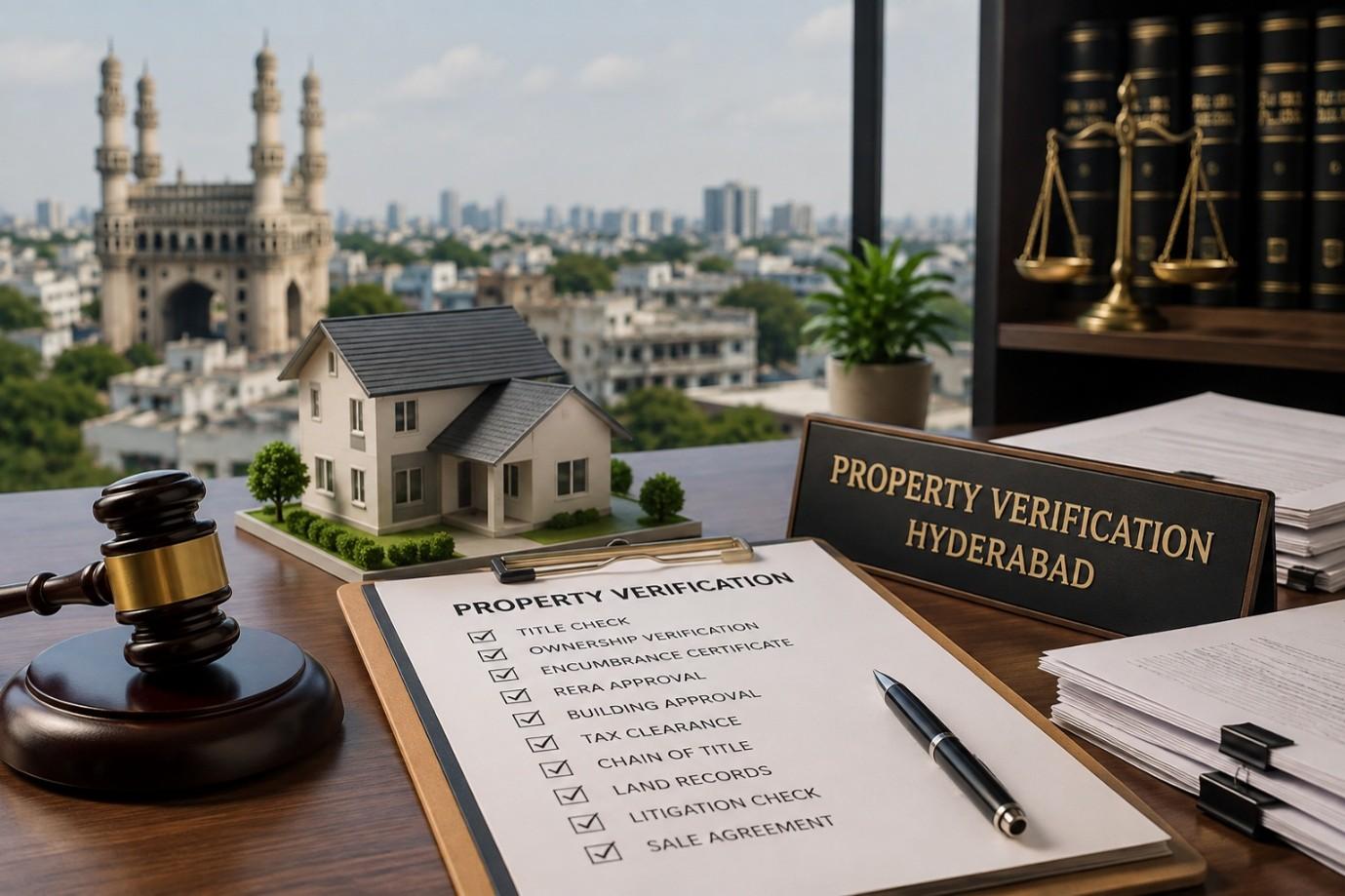
Buying a home, plot, commercial property or apartment in Hyderabad can be one of the biggest financial decisions you make.
The property may look perfect. The seller may have a registered sale deed. The builder may show attractive brochures. The broker may tell you that everything is "clear."
But none of these things, by themselves, prove that the property is legally safe to purchase.
A property can have an ownership dispute, previous transaction, mortgage, inheritance issue, incorrect survey details, unauthorized development, pending litigation or approval problem that is not obvious during a site visit.
That is why property verification Hyderabad should happen before you pay a substantial advance or sign an agreement to sell.
A proper verification process examines the property's title, ownership history, registration records, encumbrances, revenue records, approvals, litigation, RERA status where applicable, and the seller's authority to transfer the property.
At Tzedek Law, our property and real-estate law services specifically cover title diligence, RERA disputes, sale deed drafting, partition disputes and builder-buyer conflicts.
This guide explains what you should check and why each check matters.
What Is Property Verification?
Property verification is the legal and documentary process of determining whether a property can be safely purchased and whether the person selling it has the legal right to transfer it.
It is more than checking whether a sale deed exists. A proper property verification may examine:
- Current ownership
- Previous title documents
- Chain of title
- Sale deeds and gift deeds
- Partition or settlement documents
- Encumbrances
- Mortgages and charges
- Revenue records
- Mutation records
- Survey and property boundaries
- Building and layout approvals
- RERA registration, where applicable
- Pending litigation
- Acquisition issues
- Land-use restrictions
- Seller identity and authority
- Possession
- Tax and municipal records
The objective is simple: You want to know exactly what you are buying, who owns it, whether the seller can legally sell it, and whether anyone else can assert a claim over it.
Why Property Verification Is Important in Hyderabad
Hyderabad's property market includes residential apartments, independent houses, plotted developments, commercial buildings, agricultural land and rapidly developing peripheral areas. Different property types can involve different legal and regulatory issues.
For example, buying an apartment from a builder may require examination of project approvals and RERA information. Buying an inherited house may require succession and partition documents. A plot may require careful examination of title, survey boundaries and layout approval.
The Telangana government's Bhu Bharati system provides online land-record services and registered-document information. Its land-status service states that records are updated online, while its registered-document service allows searches using document number/year and registration-office details.
However, an online record should be treated as one part of due diligence rather than a substitute for a complete legal title investigation.
Suppose a seller owns a 300-square-yard plot in Hyderabad. The seller shows you a sale deed, property tax receipts, a recent EC, and a mutation record. Everything appears normal.
But an earlier owner had transferred an interest in the property to another person, and the transaction is relevant to the title chain. A simple document check may miss the issue.
A proper title search looks backward through the chain of documents and asks whether each transfer was legally supported. That is the difference between document collection and legal due diligence.
10 Essential Checks for Property Verification Hyderabad
1. Verify the Seller's Identity and Ownership
Start with the most basic question: Is the person selling the property actually entitled to sell it?
Compare the seller's identity documents with the name appearing in the title documents. Check: Full legal name, Father's or spouse's name where relevant, Address, Identity documents, Ownership share, Nature of ownership, and whether the seller is acting personally or through an attorney.
If there are multiple owners, do not assume that one person can sell the entire property. For jointly owned property, verify the rights of every relevant co-owner.
2. Examine the Complete Chain of Title
This is one of the most important parts of property verification. A title chain shows how ownership moved from one person to another. Depending on the property's history, you may need to examine: Previous sale deeds, gift deeds, partition deeds, settlement deeds, release deeds, exchange deeds, inheritance documents, court orders, succession documents, development agreements, and Power of Attorney documents.
Our practice conducts title searches extending back 30+ years and examines registration records, mutation entries and pending litigation as part of its title diligence process.
A recent sale deed only tells you about the latest transaction. It does not automatically establish that every earlier transfer was valid. A lawyer reviewing title history may therefore trace older documents to identify gaps, inconsistent ownership or unresolved claims. For details, you can verify registered document details on Bhu Bharati.

- Does each transfer connect to the next?
- Are the names consistent?
- Are property descriptions consistent?
- Do survey numbers match?
- Do boundaries match?
- Are ownership shares properly explained?
- Are original or certified documents available?
3. Check the Encumbrance Certificate
An Encumbrance Certificate (EC) is an important document used during property due diligence. It can help identify registered transactions and encumbrances reflected in the relevant registration records for the period searched.
But an EC should not be treated as a complete guarantee that a property has no legal problem. Because property disputes and legal interests can exist outside what a particular EC search reveals. For example, a dispute involving inheritance, possession, an unregistered claim, or circumstances not reflected in the searched registration records may require additional investigation.
Do not simply ask for an EC. Compare it with: Title documents, seller's ownership documents, registration details, property description, survey number, and transaction history.

4. Verify Land and Revenue Records
For plots, independent houses and land transactions, revenue records can be highly relevant. Telangana's Bhu Bharati portal provides land-status and related land-record services. Depending on the property, verification may involve checking: Survey number, sub-division number, extent, Pattadar details, land classification, mutation information, acquisition status, revenue records, and physical boundaries.
The online records should be compared with the title documents and the property on the ground. You can access Telangana Bhu Bharati land records directly.
5. Verify Property Boundaries and Survey Details
A title document may describe a property using: Survey number, plot number, door number, boundaries, measurements, and extent. These details should make sense together. A mismatch can create serious problems later.
For example: Sale deed claims 300 square yards, Revenue record claims 280 square yards, and Physical measurement is approximately 265 square yards. That is not a minor paperwork issue. It requires investigation.
Before buying land or a plot: Compare the deed with the survey records, check the property's physical boundaries, confirm the measurements, verify access roads, check whether any portion falls within a proposed road or public-use area, and obtain professional survey assistance where necessary.

6. Check for Pending Litigation
A property may appear perfectly normal until a dispute surfaces. Possible disputes include: Partition suits, ownership disputes, inheritance claims, boundary disputes, possession cases, mortgage disputes, builder-buyer disputes, land acquisition proceedings, and injunction proceedings.
A litigation search should therefore form part of serious property due diligence. If litigation exists, do not rely on the seller's statement that "the case is nothing." Have the pleadings and relevant orders reviewed by a lawyer. If you require legal assistance in checking or representing in disputes, our team provides comprehensive criminal litigation support and civil remedies.
- Is there any pending case involving the property?
- Has the seller received any legal notice?
- Are there disputes between family members?
- Has any court passed an injunction?
- Is there a partition dispute?
- Is possession being challenged?
7. Check Building, Layout and Land-Use Approvals
Ownership and development approval are separate issues. You may own land but still face restrictions on how it can be developed or used. For Hyderabad-area properties, relevant planning authorities and municipal records may need to be examined depending on the property's location.
HMDA provides information concerning layout permissions, building permissions, land use and occupancy certificates. You can look at the HMDA planning and development information . HMDA also states that building permissions, occupancy certificates and certain layout permissions within applicable HMDA areas are processed through TG-bPASS.
For properties within GHMC limits, GHMC provides building-permission processes and identifies ownership documents and linked documents among requirements for building applications. Check the GHMC building permission information .
Check where applicable: Layout approval, building permission, Occupancy Certificate, land-use permission, approved building plan, conversion or regularization records, and relevant NOCs.
8. Verify RERA Registration for Applicable Projects
If you are buying a new apartment, villa or plotted development from a builder, RERA verification can be an important part of your due diligence.
The Telangana RERA provides online access to registered projects and agents and allows citizens to access project information and complaint-related services. TG RERA itself encourages prospective homebuyers to verify project registration before investing.
Check: Project registration, promoter details, project status, approved information, project timeline, complaints or orders where relevant, and whether the property being sold matches the registered project. Do not rely only on a builder's brochure or salesperson's statement.
9. Verify Mortgages, Charges and Other Liabilities
A property can be associated with financial obligations. For example: Bank mortgage, loan security, charge, existing financing, developer mortgage, and release requirements. The seller should be able to demonstrate how any existing liability will be cleared before or as part of the transaction.
A seller says: "The property has a bank loan, but I'll close it after you pay the advance." That arrangement needs careful legal structuring. A buyer should not simply transfer a large amount based on a verbal promise.
The transaction documents should clearly address: Outstanding loan, bank involvement, release of security, payment mechanism, original document release, and registration conditions.
10. Verify the Sale Agreement and Sale Deed
Even after completing property verification, the transaction documents need careful review. The agreement should clearly cover: Property description, sale consideration, advance amount, payment schedule, completion date, seller's representations, title warranties, encumbrance obligations, possession, default consequences, indemnity, registration obligations, and document handover.
The final sale deed should accurately reflect the property and agreed transaction. The Registration Act, 1908 and Transfer of Property Act, 1882 are among the central legal frameworks relevant to transfers of immovable property. You can review the statutes on the official India Code website.
Documents to Collect for Property Legal Verification
Depending on the property, ask the seller or builder for copies of relevant documents:
Basic Documents
- Current sale deed
- Previous title deeds
- EC
- Revenue records
- Mutation records
- Property tax records
- Approved layout
- Building permission
- Occupancy Certificate
- RERA details
- Survey documents
- Identity documents
- Power of Attorney
For Inherited Property
- Death certificate
- Will, if any
- Legal-heir / succession documents
- Probate or court orders
- Partition or release deeds
- Succession rights documents
For Builder Properties
- Project registration
- Development permissions
- Approved plans
- Builder title documents
- Sale agreement
- Project disclosures
- Completion documentation
Property Verification for NRIs Buying in Hyderabad
NRIs often face an additional practical challenge: they may not be physically present to inspect documents and property records. A remote transaction should therefore receive even more attention.
An NRI buyer should consider:
- Obtaining the complete document set before making payment.
- Conducting independent legal title verification.
- Verifying the seller directly.
- Checking the Power of Attorney carefully if someone is acting on the buyer's behalf.
- Conducting an independent site inspection.
- Verifying registration and revenue records.
- Reviewing the agreement before signing.
- Using secure payment mechanisms.
- Keeping copies of all documents and correspondence.
Do not appoint a representative merely because the seller or broker recommends that person.
Common Property Verification Mistakes
- Mistake 1: Trusting the BrokerA broker can provide useful commercial information, but a broker is not a substitute for independent legal due diligence.
- Mistake 2: Checking Only the ECAn EC is important, but title verification goes beyond one certificate.
- Mistake 3: Ignoring Old DocumentsA recent deed cannot automatically cure an older defect in the title chain.
- Mistake 4: Paying a Large Advance Too EarlyAvoid committing substantial funds before completing essential legal checks.
- Mistake 5: Ignoring ApprovalsA property may have ownership documents but still have development or approval problems.
- Mistake 6: Assuming RERA Solves Every Title IssueRERA registration is important for applicable projects, but it does not eliminate the need for independent legal title diligence. If conflicts occur with builders or developers, you should check how we handle builder-buyer and consumer disputes.
- Mistake 7: Not Checking LitigationA dispute can dramatically affect the value and usability of property.
- Mistake 8: Using One Professional for EverythingA broker, bank, architect and lawyer may each have different roles. Independent legal review can identify risks that commercial participants may not highlight.
How a Property Lawyer Helps With Due Diligence
Professional property verification is particularly useful when the property has: a long ownership history, multiple owners, inherited ownership, development agreements, Power of Attorney transactions, previous mortgages, litigation, layout issues, survey discrepancies, builder involvement, RERA concerns, agricultural-to-residential conversion questions, or NRI involvement.
Tzedek Law's property and real-estate practice specifically identifies title verification, RERA matters, partition disputes, sale-deed drafting and builder-buyer conflicts among its services. The value of a lawyer is not simply reviewing whether documents exist. The real value is understanding what those documents mean together.
Do not automatically walk away from every property where an issue appears. Some problems can potentially be resolved (e.g., obtaining a missing document, releasing a mortgage, correcting a name discrepancy, or clarifying a boundary). But the correct response depends on the nature of the defect.
The Safe Approach: Identify → Investigate → Assess Risk → Resolve if Possible → Document the Resolution → Proceed Only When Satisfied. Do not allow a seller to pressure you.
When Should You Conduct Property Verification?
The ideal time is before you commit significant money and before signing binding transaction documents.
A practical sequence is:
Step 1: Shortlist the Property - Confirm the commercial details.
Step 2: Collect Documents - Ask for the complete title and property document set.
Step 3: Conduct Legal Due Diligence - Review ownership, title chain, encumbrances, litigation and approvals.
Step 4: Inspect the Property - Compare documents with the physical property.
Step 5: Resolve Red Flags - Ask the seller for documents and explanations.
Step 6: Negotiate the Agreement - Build legal protections into the agreement.
Step 7: Complete Registration - Proceed only after the legal and commercial conditions are satisfactory.
Conclusion
Property verification is not a formality to complete after you have decided to buy. It is one of the most important steps you can take before committing your money.
A property may look attractive, have a registered document and come with reassuring statements from a seller or broker. What matters legally is whether the title is properly established, whether the seller has authority to transfer the property, whether the records are consistent, whether relevant liabilities or disputes exist, and whether applicable approvals are in place.
For property buyers in Hyderabad, a sensible due-diligence process should examine the title chain, Encumbrance Certificate, revenue records, survey details, litigation, approvals, RERA information where applicable, mortgages and the final transaction documents.
The safest approach is simple: Verify first. Pay later.
If you are purchasing a flat, house, plot, commercial property or land in Hyderabad and want an independent legal review, professional property verification can help you understand the risks before the transaction becomes difficult to reverse.